Vous avez sans doute remarqué, ces dernières années, l’intrusion de plus en plus visible des États dans le fonctionnement des réseaux sociaux, des messageries et, plus largement, d'Internet.
You have probably noticed, in recent years, the increasingly visible intrusion of governments into the functioning of social networks, messaging platforms, and the Internet as a whole.
This is not a coincidence. It is a strategic shift.
The End of the Free Internet and the Rise of Digital Sovereignty
For decades, the core of public opinion formation was located on television and within traditional media.
This model began taking shape in the 1950s and long remained the primary tool governments used to shape narratives, steer debates, and impose official storylines.
A monopoly that lasted roughly 70 years.
But that world is over.
The Core of Information Has Shifted
Even the slowest Western elites to grasp technological change have finally acknowledged it: public opinion is no longer shaped by television or traditional media.
It is now shaped on social networks and, more broadly, on the internet, which increasingly offers alternative media platforms.
Television Is Demographically Dead
Social media has demonstrated one essential fact: the vast majority of the population no longer consumes information through traditional channels.
Add to this a fundamental demographic factor: the “television generation” is aging and gradually disappearing, while the generations replacing it have grown up exclusively with the internet and social media.
It does not take a genius to understand what this implies.
Television now has only a marginal impact on shaping the opinions of younger generations.
According to the Digital News Report by the Reuters Institute, more than 70% of 18–34-year-olds now get their news primarily through the internet and social media.
Television retains a dominant position only among those over 55, a population that is aging and demographically declining.
At the same time, around 60% of citizens now report being exposed to news via social media, compared to barely 40% through television news broadcasts.
Information is therefore no longer actively sought through centralized channels, but passively encountered within decentralized digital feeds. This shift explains the gradual relocation of the informational center of gravity toward the internet and, by extension, the loss of state control over the formation of public opinion.
The States’ Panic
For decades, television was the central instrument of narrative control for governments.
Today, states are abruptly realizing that they have lost that tool.
The reaction is therefore logical, almost mechanical.
To maintain ideological control over the next generations, governments must shift their focus, their pressure, and their legal arsenal toward social media and the internet.
That is exactly what we are witnessing.
Explosion of Censorship and Control
In recent years, control measures, censorship, and political actions aimed at silencing dissenting voices have surged dramatically.
And this trend is only just beginning.
This is not about protecting anyone, nor about defending a particular idea or taboo.
It is about regaining control of the narrative.
The more a state feels it is losing control over its population, the more it attempts to tighten that control.
It is a well-known historical pattern: when power starts to wobble, it turns authoritarian, even tyrannical.
Pressure, Intimidation, and Backdoors
Recently, we have seen Western governments intensify pressure on digital platforms and messaging services.
Arrests, searches, judicial intimidation, threats of sanctions — nothing is off the table.
The correlation is clear: internal political loss of control = authoritarian tightening.
The countries where governments are politically the most fragile are precisely those where attacks on freedom of expression are the most aggressive.
France is a striking example. The country is facing severe economic strain and deep structural decline, which, as you now understand, only reinforces authoritarian tendencies within the government. Authorities have multiplied attacks on free speech, as illustrated by the arrest of Pavel Durov and the search of X’s offices in Paris.
The “Protect the Children” Pretext
The laws allegedly designed to “protect children on social media” fit perfectly within this logic.
They are disguised control mechanisms.
The real objective is not the protection of minors. It lies elsewhere.
These laws aim to introduce mandatory identification systems for the entire population in order to eliminate anonymity, track every individual, and more effectively suppress dissenting voices.
Les États occidentaux se soucient peu du sort des enfants, ça serait nous prendre pour des imbéciles, surtout quand on sait, preuves à l'appuei, que la majorité des élites occidentales sont impliquées dans l'affaire Epstein.
No — Western elites are concerned above all with control.
A Generational War
Ces mesures ont également un autre avantage stratégique pour les États occidentaux, qui essayent de faire d'une pierre, deux coups en bloquant l'accès aux jeunes.
For several years now, younger generations have increasingly leaned to the right, while older generations — shaped by the television era — remain predominantly on the left.
Eh oui, quand les jeunes voient le réel, c'est très difficile ensuite de leur vendre des histoires.
Limiting young people’s access to social media therefore also means:
- ralentir leur politisation autonome (car la confrontation au réel à tendance à les "droitisé")
- empêcher l’exposition à la réalité brute du terrain (qu'on ne peut plus cacher)
- continuing ideological conditioning through schools and traditional media
Car le réel ne peut pas être caché sur les réseaux sociaux : violences, insécurité, immigrations massive, scandales, colères populaires, chômage de masse, départs massifs à l'étranger des entrepreneurs et travailleurs etc.
Images that television often refuses to show.
Two Strategies in the World
At the global level, we can now observe two major methods of control.
- Première méthode : la perversion des réseaux sociaux
Principalement utilisée par les pays occidentaux.
Elle consiste à vous laisser croire que vous êtes libre, tout en manipulant massivement les algorithmes, en favorisant le narratif officiel et en attaquant juridiquement les voix dissidentes. Un modèle qu'on appelle souvent orwellien.
Un cadeau empoisonné : vous utilisez la plateforme, mais elle travaille contre vous, manipule votre perception de la réalité, vous désinforme en permanence et aspire vos données.
- Deuxième méthode : l’interdiction pure et simple
Certains pays, comme la Russie, la Chine et d'autres, préfèrent bloquer directement les plateformes qu’ils ne peuvent pas contrôler. C’est brutal, mais au moins le message est clair.
Parfois, cette interdiction est accompagnée de la promotion d’une alternative contrôlée par l’État : en Russie ce sera MAX, en Chine ce sera WeChat. Pour eux, les réseaux sociaux ne sont pas simplement des outils de communication libre. Ce sont aussi des instruments d’influence étrangère potentiellement hostiles. La majorité des grandes plateformes étant occidentales, elles représentent, à leurs yeux, un double risque : d’un côté la captation des données à grande échelle, de l’autre une capacité d’ingérence informationnelle pouvant servir des objectifs géopolitiques. Dans cette logique, bloquer ou encadrer ces plateformes ne relève pas seulement du contrôle interne, mais aussi d’une stratégie de défense informationnelle face à des infrastructures numériques perçues comme étrangères et potentiellement hostiles. Voilà pourquoi ces pays optent en général pour un blocage pur et simple des réseaux sociaux provenant des puissances étrangères.
À titre personnel (cela n'engage que mon avis), pour un citoyen, la deuxième méthode est tout de même préférable.
Déjà parce qu'elle est presque plus honnête, mais surtout, parce que rien n'est pire que de se faire aspirer toutes ses données par l'État. Donc à choisir, mieux vaut une interdiction assumée, qui au moins me permet de protéger mes données et mon identité, plutôt qu’une liberté illusoire fondée sur la manipulation et la surveillance de masse, qui a la fin, me rend beaucoup plus vulnérable et fragile dans la société.
Entering a New Era
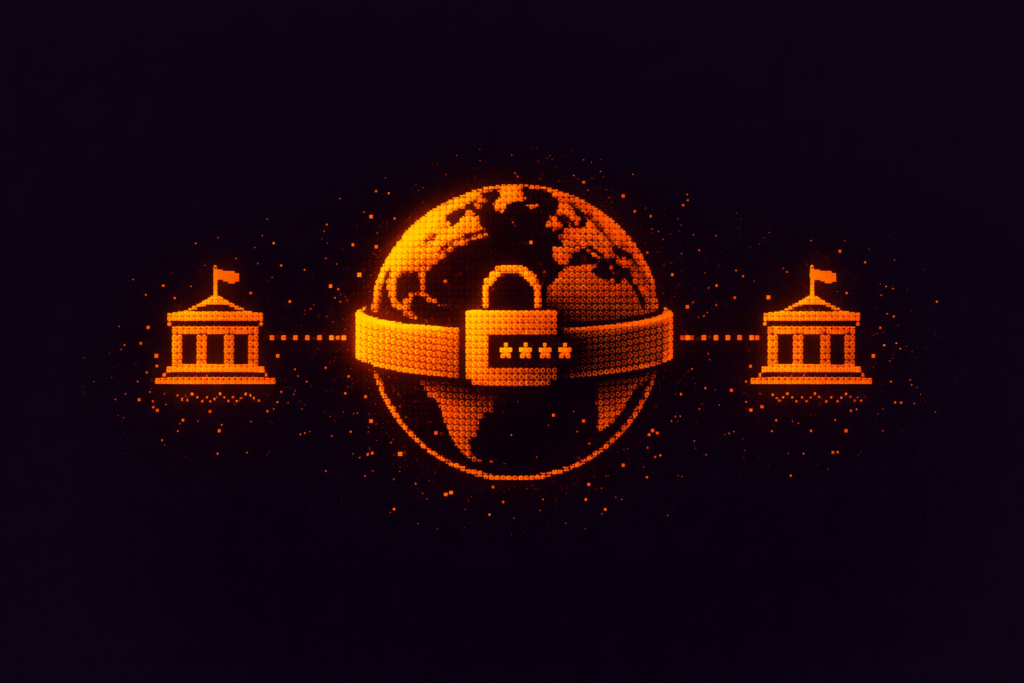
In this new era of controlled Internet, the daily life of the average citizen is transforming subtly yet profoundly.
Where the early free Internet once allowed largely anonymous browsing, spontaneous exchanges, and direct exposure to a plurality of viewpoints, the digital space is now becoming a monitored, filtered, and conditioned environment.
Every interaction leaves a trace. Every account is increasingly tied to a real identity. Every public statement is potentially archived, analyzed, and cross-referenced.
Platforms remain accessible on the surface, but algorithms silently shape what content is visible, reduce the reach of non-conforming speech, and promote narratives validated by political or institutional power.
The citizen is no longer openly censored; instead, they are made invisible, discouraged, and sometimes sanctioned administratively, economically, or even legally.
Compared to the free Internet of the 2000s and 2010s, where surveillance existed but remained fragmented and technically limited, the controlled Internet operates through systemic, industrialized monitoring—enabled by big data, artificial intelligence, and the gradual imposition of identity verification.
The network is no longer a space of spontaneous emancipation, but a fully political territory, where freedom of expression becomes conditional, reversible, and closely tied to the individual’s ability to protect their digital sovereignty.
The End of the Free Internet Has Already Begun
In any case, one thing is certain: the age of the free Internet is coming to an end.
We are entering the era of the controlled Internet.
And as always throughout history, every attempt at control inevitably generates strategies of circumvention by the population.
C’est aussi vieux que le monde et l'Histoire déborde d'exemples, comme la Samizdat ou la Prohibition.
After the Free Internet: The Age of Digital Sovereignty
All these strategies of protection, circumvention, and resilience can be grouped under one term: data privacy.
Sometimes labelled as data protection, sometimes also referred to as digital sovereignty.
And this is precisely the subject that now lies at the core of my work.
Because the further we move into this new paradigm, the more digital sovereignty becomes a central issue, connected to all others.
It is inseparable from freedom of expression, the foundation of any free society.
Ce n'est pas pour rien que c'est le premier amendemant aux USA.
The Sentinels
If you want to prepare for the world we have just entered, if you want to understand how to protect your anonymity, your data, and your freedom of expression, I invite you to follow me.
I am building here a community centered around this very concept of digital sovereignty.
It is called The Sentinels.
Pre-registration to join The Sentinels community and access the new Discord server is now open.
Le lien pour s'inscrire : thegeosentinel.com/communaute-les-sentinelles
0 Comments