As mass surveillance intensifies, the shift from Windows to Linux is becoming increasingly obvious for many people. For some, this transition is already seen as unavoidable.
When your computer turns into a permanent surveillance tool, collecting every piece of data and every click, and when it becomes nearly impossible to refuse or disable these mechanisms, a new reality emerges: it is time to move away from Windows and switch to a truly free and sovereign operating system.
In the face of this ongoing technological drift, this choice is no longer a geek whim, as it was sometimes portrayed twenty years ago. It is becoming an essential step to protect your privacy, your files, and more broadly, your digital security.
It is time to regain control of your hardware. To say no to forced updates. To stop feeding tech giants that have become surveillance infrastructures, increasingly exploited by corporations for borderline commercial purposes and by governments for political control.
The problem with Windows (and Apple)
The shift happened slowly, almost imperceptibly. Through a series of small concessions, we gradually accepted the unacceptable: our computers no longer truly belong to us.
They have become permanently connected terminals, rented at a high price, collecting and transmitting data in the background about our private lives and even our smallest actions.
Trust is no longer possible
Microsoft crossed a point of no return with Windows 11 and the forced phase-out of Windows 10.
From now on, surveillance and intrusion operate by default, without any real possibility of informed consent.
This structural opacity breaks the original contract of trust.
Creating a Microsoft account is gradually becoming the norm. The desktop is turning into a promotional interface. You are no longer working on a neutral tool, but inside an environment designed to integrate services, capture attention, and push you toward the cloud.
AI Copilot is now embedded at the very core of the system. Forced updates alter the environment without meaningful user control. As these layers accumulate, control becomes diluted. And with it, an increasingly significant portion of our digital sovereignty.
Linux, or the return of digital sovereignty
Faced with the constant intrusion of Windows 11, migrating to Linux becomes a necessary break in order to finally regain control over your own machine.
Why Linux Changes the Game
While Microsoft continues to move toward a model centered on data collection and control, Linux represents the opposite logic: transparency and user control.
Its source code is open and accessible to everyone. This openness makes it far more difficult to discreetly insert backdoors. No single actor can sustainably hide surveillance functions without being exposed to public scrutiny.
This is about full digital sovereignty.
Owning your software and controlling your system frees you from dependence on American multinationals.
Your files are no longer subject to their strategic decisions or corporate interests.
A vast global community constantly monitors the ecosystem.
Thousands of developers publicly fix security vulnerabilities and improve the system in a transparent way.
Software transparency remains one of the strongest foundations of digital security.
It is the basis of trust. And that is precisely the principle on which Linux is built.
An Architecture Without Parasitic Services and Highly Customizable
The system’s modular design acts as a true technical shield. You install only what is strictly necessary.
This mechanically reduces the attack surface against external threats.
Commercial profiling disappears entirely from your life.
Linux never attempts to sell your browsing habits. No advertisements are pushed into your start menu.
Linux never attempts to sell your browsing habits. No advertisements are pushed into your start menu.
Native encryption protects your data, and sandboxing effectively isolates and blocks threats.
Linux Has Become More Accessible Than Ever
Forget the cliché of a bleak black screen filled with cryptic lines of code.
The reality of installing Linux today is far more welcoming for those who want to leave the ecosystem of Microsoft and Apple giants.
Installation Has Become Effortless
Linux Mint and Zorin OS are seriously challenging old misconceptions.
These systems brilliantly replicate the ergonomics of Windows.
An average user finds their bearings within minutes. There is no need to learn an entirely new system.
Software repositories function like mobile app stores. You install your favorite programs with a single click. Everything is centralized, clean, and secured against threats.
Everything is centralized, clean, and secured against threats.
Stability has become the norm. Modern desktop environments are smooth and visually polished.
Gaming and productivity without any compromise
And one of the major shifts that has significantly accelerated Linux adoption in the market is that, over the past three years, one of the biggest barriers has disappeared: video gaming is no longer an obstacle.
Thanks to Steam, the majority of Windows games now run flawlessly.
Performance matches, and in some cases even surpasses, Windows on most computers.
On the productivity side, the past five years have also brought major improvements. OnlyOffice and LibreOffice now offer full compatibility.
Exchanging Word or Excel files is now seamless and free of bugs.
Working and collaborating finally feels smooth again.
Printers and scanners are recognized instantly.
The necessary drivers are already integrated into the system kernel.
Graphic creation has also become independent.
Intrusive proprietary software suites can now be replaced with powerful open-source alternatives.
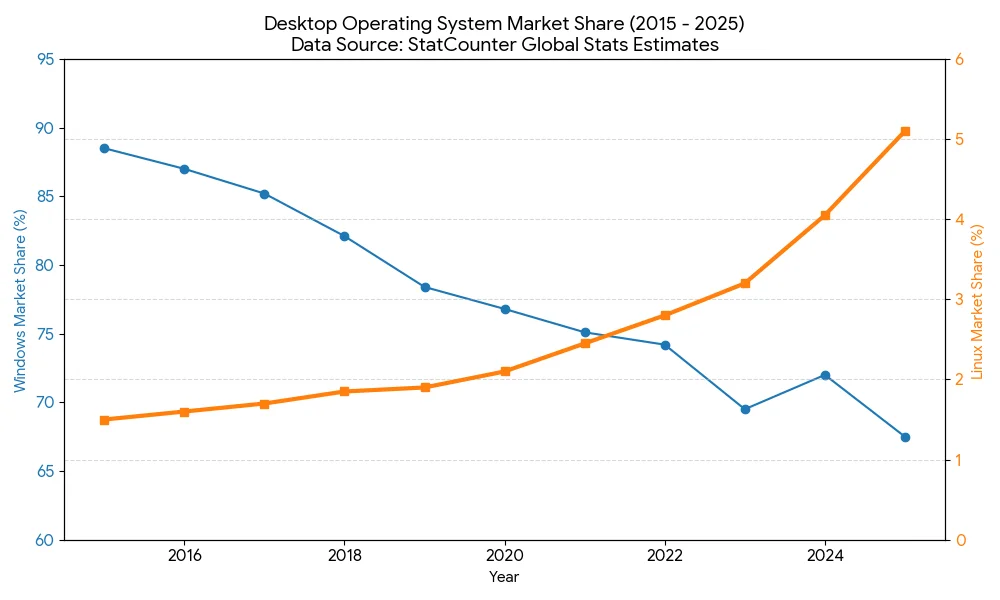
All these barriers that have fallen in recent years have significantly increased Linux’s market share, while Windows continues to decline.
Why More and More People Are Migrating
Distrust toward imposed surveillance is exploding.
Distrust toward imposed surveillance is exploding.
This mass data collection is pushing more and more citizens toward systems that genuinely respect privacy.
People simply want to regain control.
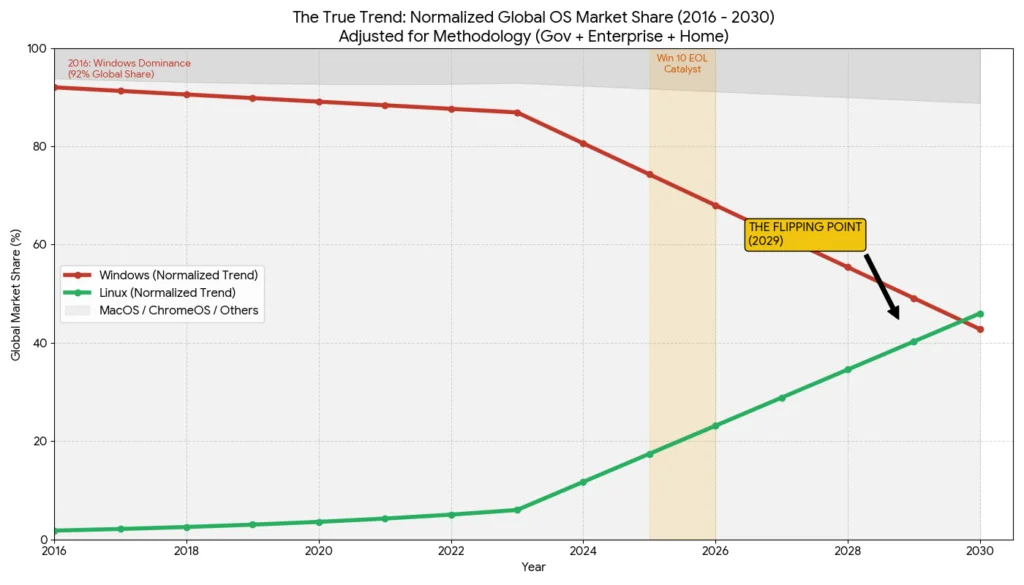
We are witnessing a historic turning point in global digital habits: the growing fatigue and loss of trust in Windows now perfectly coincide with Linux’s ergonomic maturity, which has become simple and accessible.
Today, the user experience is stable, smooth, and fully suited for professional use.
The strong community dynamic around Linux makes adoption easier than ever. Almost anyone can now take the leap.
Tutorials are clear, resources are abundant, and the transition has become accessible even for the most hesitant users. Once seriously tested, many choose to stay.
What is even more striking is that the collective awareness around privacy protection has, coincidentally or not, aligned with a political awakening at the European level.
Large companies, institutions, and numerous organizations across Europe have finally realized how much their dependence on American tech giants has placed them in a position of vulnerability. In recent years, a movement to reclaim digital sovereignty has therefore begun among hundreds of companies and institutions.
Migrations to Linux are multiplying, sometimes involving tens of thousands of workstations within companies and public bodies across Europe.
If this dynamic continues, Linux is clearly on a trajectory that could signal a major paradigm shift within the next five years.
Why You Should Consider the Transition
Beyond the technical aspect, what is at stake is a societal choice and a matter of individual freedom.
A growing awareness of digital sovereignty
For most people today, the computer is the foundation of their digital life.
Your security and privacy protection depend first and foremost on this central tool.
If that foundation is compromised or functions as a permanent data-collection mechanism, it becomes logical to look for a more respectful alternative.
Privacy is a fundamental right. It is not a luxury reserved for the paranoid.
It is an essential condition for preserving freedom of thought and action. When that freedom is weakened by excessive technological control, it is natural to want to defend it.
Taking back control requires an initial effort. But the process is profoundly liberating.
Stop passively accepting the decisions of software giants. Choose your digital autonomy.
Sovereignty Starts at the Foundation
The web has become a true battlefield.
Your personal data, information itself, has become the new oil coveted by tech giants.
These corporations extract every fragment of your private life, without hesitation.
The most coherent response to surveillance is to leave Windows behind, and millions of people have understood this and are now turning to Linux.
Making the Move Gradually
For those who are still hesitant, there are gentle ways to test the waters before fully committing.
Live USB: Test Without Changing Anything
You simply plug in a bootable USB drive at startup.
Linux then runs directly from that external device.
Your hard drive remains untouched, with no deep technical modifications.
This allows you to check hardware compatibility in real conditions. It is the perfect way to explore the interface without taking any risks.
You can explore the system as a guest.
Dual boot is another option, allowing you to keep Windows and switch between systems whenever you want.
A small utility such as Rufus prepares everything. The process becomes straightforward.
Revive Your Old Computer
The final advantage is that Linux stands out for its remarkable efficiency.
The system consumes very few resources.
A machine that struggles under Windows often regains smooth performance with Linux.
Daily tasks run without frustrating slowdowns or constant bugs.
Extending the lifespan of your hardware reduces electronic waste. You avoid buying a new computer and save money.
This free solution gives real value back to older hardware.
The financial savings are far from negligible.
In most cases, you do not even need to buy a new computer to install Linux. Your current device will often feel revitalized after the transition.
Now it is your turn to take back control of your data.
Because sovereignty is not negotiated. It is installed.
To find out more:
Why Nations and Giant Corps Are Quietly Quitting Windows 100+ Examples


0 Comments